Who Controls the Record Controls the Truth

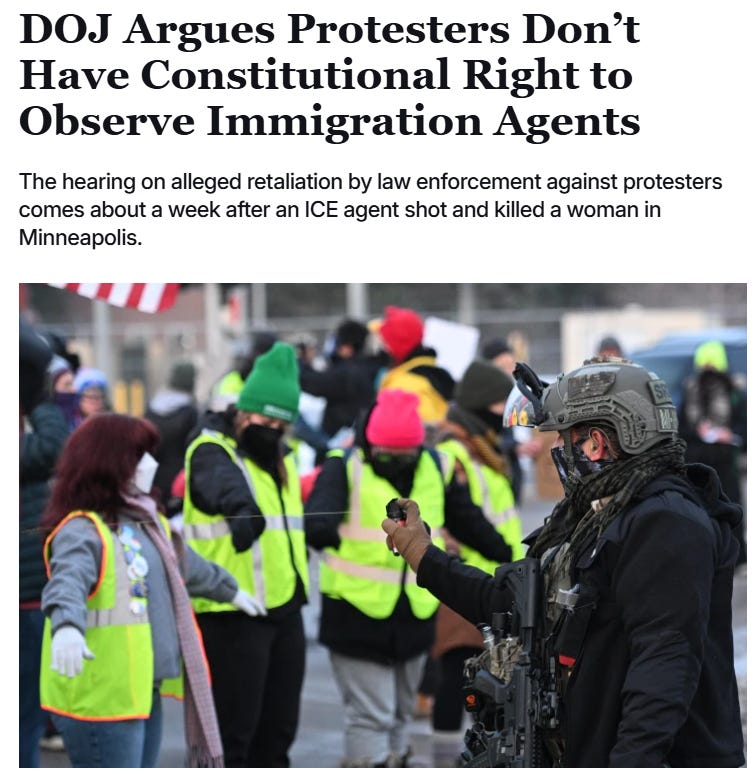
Politics has met the area I live/work in - so let me spell some things out.
It does not matter what side of the political aisle you are on, or where you land on the Renee Nicole Good case for the purpose of this post. I reference it only because I know it will be mentioned. It is not the focus.
This post is not about guilt, innocence, justification, or blame.
If the discussion gets dragged there, the point is lost.
History shows many moments where public recording mattered. Rodney King is one example. There are many others. The pattern is consistent. When events are visible, accountability exists. When they are not, it does not.
Set opinions aside and look at control itself. No matter who holds it, control concentrates.
Concentrated control always corrupts outcomes in some form.
This is about precedent.
This is not just a U.S. issue. This is about what can happen in Canada as well.
Legal arguments made in one country have a habit of crossing borders, especially when they involve policing, surveillance, and state power.
We cannot go down this path.
The issue is simple. Who is allowed to observe power in public, and who controls the record of what happens when force is used?
I talk about a surveillance society from two angles. One is Big Tech and Big Brother inside your home. The other is Big Tech, the state, and bad actors on the street.
Both matter.
Both shape behavior.
Both determine who gets believed when something goes wrong.
There is a critical difference between decentralized recording and centralized control.
Decentralized security cameras operated by independent parties, including door cams and personal phones, create redundancy. Multiple angles. Multiple timestamps. Multiple owners of the truth. No single authority decides what survives and what disappears.
Centralized systems do the opposite. They concentrate control. One system. One policy. One chain of command. That means footage can be withheld, edited, delayed, or erased. Even when done legally, the incentive structure is wrong. Trust drops because control is opaque.
This is not theoretical.
History already shows that many cases of misconduct only surfaced because civilians recorded them.
Not because internal systems worked.
Not because oversight boards caught it.
Because someone nearby pressed record.
When people film something that looks wrong, that is not interference.
It is accountability.
Policing is supposed to work both ways.
Observation is not obstruction.
Phones and visible cameras matter here.
They are obvious. Everyone knows they are there.
That visibility alone changes behavior and often de-escalates situations. They protect civilians, and they protect good officers by creating an objective record instead of relying on memory, reports, or narratives written after the fact.
Removing the right to record does three dangerous things.
First, it shifts narrative control upward. If only the state can record, the state controls what is released and when.
That is not transparency.
Second, it removes independent verification. Multiple recordings allow events to be corroborated. A single official source creates a single point of failure.
Third, it changes behavior. When power knows it cannot be observed, behavior drifts. That is not an insult.
That is human nature - like it or not.
Wearable cameras like glasses complicate this further.
They can be abused by bad actors, especially when hidden or centralized.
The answer to that risk is not banning public recording.
It is resisting hidden, centralized surveillance while protecting open, visible, decentralized observation.
Laws that prevent citizens from recording police in public spaces do not increase safety.
They reduce accountability.
They favor control over trust.
Allowing citizens to record police is not anti-police. It protects good officers as much as it exposes bad ones. It replaces rumor with evidence.
Once a government argues that citizens have no right to observe or record state force in public, the precedent is set.
It does not stay narrow.
It expands.
That is the issue - and it a massively big one!