When Encryption Isn’t the Problem
What recent attacks on signal and WhatsApp reveal about communication systems

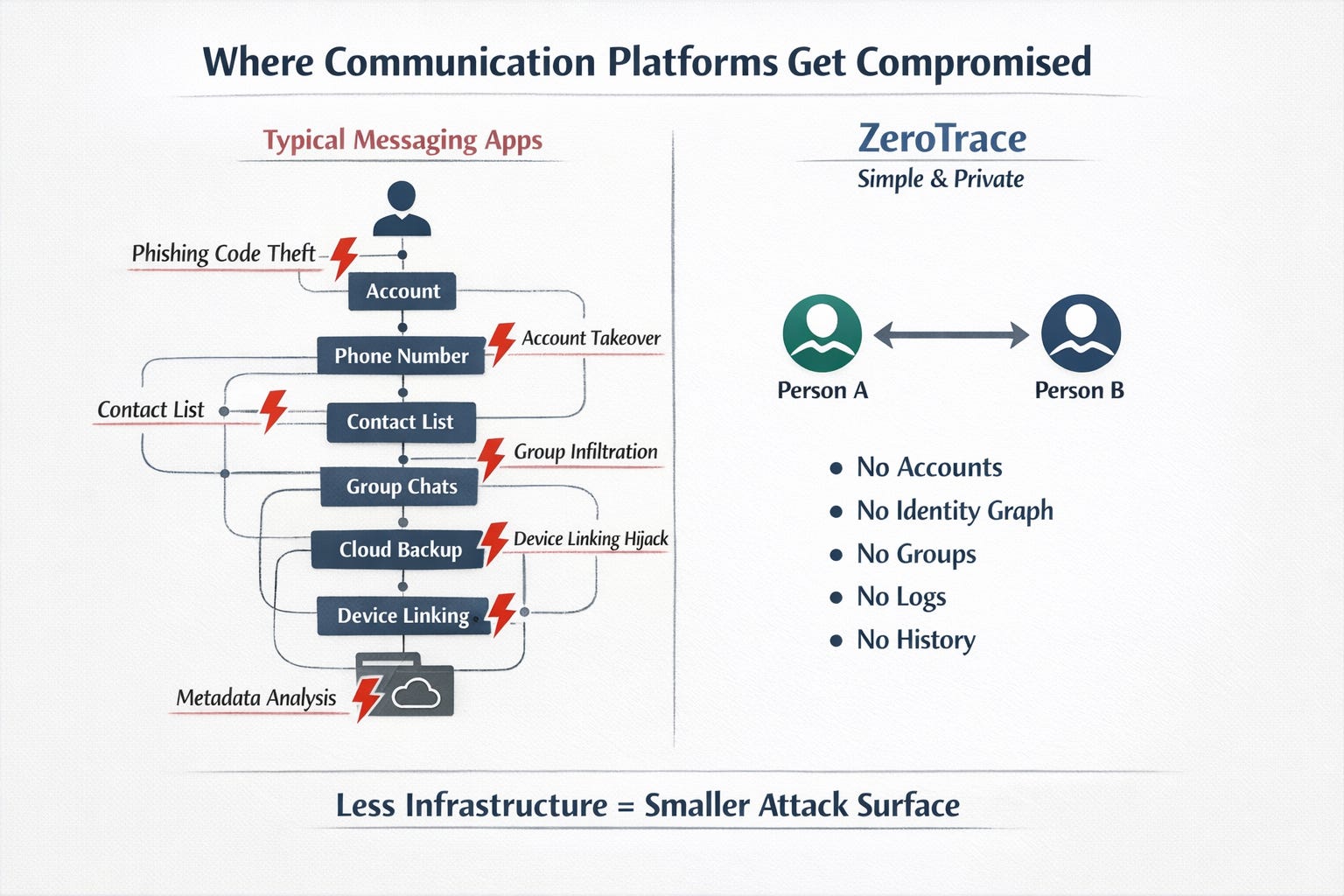
A recent intelligence warning out of the Netherlands reported that Russian state-backed hackers have been targeting users of encrypted messaging platforms like Signal and WhatsApp.
The headline alone is enough to trigger a familiar reaction:
“Encrypted messaging isn’t safe.”
That conclusion misses the real lesson.
The encryption itself was not broken.
Instead, attackers targeted the layers surrounding encryption.
They used phishing, impersonation of support services, and social engineering to trick users into revealing authentication codes or linking additional devices.
Once a malicious device is linked to an account, it can quietly receive copies of messages.
The cryptography remained intact.
The vulnerability was the system architecture and identity layer.
That distinction matters.
The Hidden Attack Surface in Modern Messaging Platforms
Most modern messaging platforms evolved to support large social networks and collaboration. That requires a lot of infrastructure beyond the message encryption itself.
Platforms like Signal and WhatsApp include things like:
* Persistent user identities
* Phone number accounts
* Device linking
* Contact graphs
* Group chats
* Broadcast messaging
* Message history
* Administrative features
All of those features exist for good reasons. They make communication convenient and scalable.
They also create additional attack surfaces.
When attackers gain access to an account, they gain access to the entire communication graph connected to it.
They can:
* silently join conversations
* observe group discussions
* collect metadata about relationships
* capture future communications
The encryption still works perfectly. But the attacker has effectively become a legitimate participant in the system.
This is the difference between breaking encryption and **infiltrating a communication network.
Most real-world intelligence operations focus on the second approach.
The Intelligence Value of Group Communication
There is another layer to this story that is rarely discussed.
Group communication dramatically increases the intelligence value of a compromised account.
In a typical messaging system, a single account can be connected to:
* dozens of group chats
* hundreds of contacts
* long message histories
* shared files and media
If an attacker compromises that account, they gain insight into an entire network of people.
The scale of intelligence collection increases rapidly.
One compromised identity can reveal:
* political conversations
* business negotiations
* activist coordination
* personal relationships
* organizational structure
This is why intelligence agencies often prioritize infiltrating **identity networks** rather than breaking encryption algorithms.
The network itself becomes the source of information.
The Architecture Question
This raises a deeper question about communication systems.
Is it possible to reduce the attack surface by reducing the system itself?
Most platforms solve problems by adding features.
There is another design approach that goes in the opposite direction.
Instead of adding more layers, it removes them.
The Minimalist Model
ZeroTrace was built around a very simple premise.
Two people should be able to talk privately without the conversation turning into permanent infrastructure.
That led to a set of strict design constraints:
* Zero groups
* Zero contact lists
* Zero persistent identities
* Zero message history
* Zero centralized logs
Every interaction is strictly one-to-one.
When the session ends, the connection disappears.
There is no account to compromise.
There is no identity graph to map.
There is no message archive to breach.
The system intentionally avoids creating the kind of network structure that attackers typically exploit.
Limiting Coordination Scale
Another important consequence of this architecture is that it limits coordination scale.
Large coordination requires:
* shared spaces
* discoverable identities
* persistent communities
* stored conversations
Traditional messaging platforms enable these features because they are designed to support communities and organizations.
ZeroTrace intentionally avoids them.
The system does not attempt to become a social platform.
It simply allows two people to communicate privately.
By strictly limiting coordination scale, we reduce the ability for bulk data collection and retroactive message reconstruction.
The Reality of Bad Actors
Designing privacy systems inevitably raises an uncomfortable question.
If privacy tools exist, bad actors can use them too.
That reality cannot be ignored.
But the alternative is also troubling.
The existence of misuse does not negate the need for privacy protections for innocent individuals. Privacy is not reserved for perfect behavior; it is a fundamental human safeguard.
The same digital traces that help investigators in some cases also expose victims, whistleblowers, journalists, and ordinary people whose private conversations were never meant for public scrutiny.
History shows that information collected for one purpose can easily be misused for another.
Privacy systems exist to reduce that risk.
Encryption vs. System Design
The Dutch intelligence warning highlights an important truth about modern communication security.
Encryption alone is not enough.
Security also depends on:
* identity management
* account architecture
* metadata collection
* coordination features
* human behavior
ZeroTrace focuses on structural privacy architecture, not device security. We do not claim to defeat spyware implants, but we reduce centralized logging and stored metadata
A system with strong encryption but complex identity networks may still be vulnerable to infiltration.
A simpler system with fewer layers may reduce those opportunities.
This is not a question of which platform is “better.”
Different systems solve different problems.
Platforms like Signal and WhatsApp are designed to support large communication networks.
ZeroTrace was designed to do the opposite.
Reducing Systemic Surveillance
At its core, the philosophy behind ZeroTrace is about minimizing the accumulation of data.
The architecture focuses on four principles:
Reducing systemic surveillance
Eliminating centralized logging
Minimizing metadata
Limiting coordination scale
These principles do not eliminate risk entirely.
No communication system can.
But they shrink the blast radius when something goes wrong.
There is simply less infrastructure to compromise.
A Different Direction for Communication Technology
Over the past two decades, most communication platforms have evolved toward greater scale, greater connectivity, and greater data accumulation.
That trend has produced enormous benefits.
But it has also created systems where vast amounts of human interaction are permanently stored, indexed, and analyzed.
ZeroTrace explores a different direction.
It asks a simple question:
What would a communication system look like if it minimized the creation of data in the first place?
Not every conversation needs to become part of a permanent digital record.
Sometimes two people just need to talk... and when they are finished, the conversation should simply end.